
What is Plane sailing? Explained
PLANE SAILING:
1. Introduction to Plane Sailing
Plane Sailing, one of the most fundamental and historically important methods of marine navigation.
Plane sailing is a method of calculating a ship’s position and distance run by assuming that the surface of the Earth is a flat plane rather than a curved sphere. This assumption allows navigators to apply simple plane trigonometry to solve problems involving course, distance, difference of latitude, and departure.
Although modern navigation relies heavily on GPS, ECDIS, and electronic systems, plane sailing remains critically important. It forms the foundation of navigational understanding and is still taught because:
- It develops spatial and mathematical awareness
- It explains the logic behind other sailing methods
- It is reliable for short distances
- It is essential knowledge for nautical examinations
In simple terms, plane sailing answers this question:
“If a ship sails on a certain course for a certain distance, how far north or south and how far east or west will it move?”
2. Historical Background and Importance
Plane sailing is one of the oldest navigational techniques. It dates back to a time when sailors navigated using:
- The magnetic compass
- Log line for speed
- Dead reckoning
- Simple charts
Before accurate chronometers and spherical trigonometry were available, navigators needed a practical and quick method. Since most coastal voyages and early ocean passages covered short distances, the curvature of the Earth was negligible, making plane sailing sufficiently accurate.
Even today, officers are expected to understand plane sailing because:
- It is the basis of Dead Reckoning (DR)
- It helps detect errors in electronic navigation
- It strengthens understanding of latitude and longitude
- It is frequently tested in oral and written exams
3. Fundamental Assumptions of Plane Sailing
Plane sailing is based on three key assumptions:
- The Earth is flat over the distance travelled
- Meridians are parallel straight lines
- Parallels of latitude are straight and parallel
These assumptions are not true globally, but for short distances (generally under 600 nautical miles), the resulting error is very small and acceptable for practical navigation.
Because of these assumptions, we can use right-angled plane triangles instead of spherical triangles.
4. Basic Terminology Used in Plane Sailing
To understand plane sailing clearly, we must define its key terms.
4.1 Course (C)
Course is the direction in which a ship travels, measured in degrees from true north, clockwise from 000° to 360°.
Example:
- 090° = due east
- 180° = due south
4.2 Distance (D)
Distance is the length of the ship’s track, measured in nautical miles.
1 nautical mile = 1 minute of latitude
4.3 Latitude
Latitude is the angular distance north or south of the equator, measured in degrees and minutes.
4.4 Difference of Latitude (D’Lat)
Difference of latitude is the north–south distance between two positions.
- Northward movement → North latitude
- Southward movement → South latitude
Measured in minutes, where:
- 1 minute = 1 nautical mile
4.5 Departure (Dep)
Departure is the east–west distance made by the ship.
- Eastward → East departure
- Westward → West departure
Departure is measured in nautical miles, but it is not equal to difference of longitude except at the equator.
5. The Plane Sailing Triangle
At the heart of plane sailing lies a right-angled triangle, known as the plane sailing triangle.
The three sides are:
- Hypotenuse → Distance travelled
- Vertical side → Difference of Latitude
- Horizontal side → Departure
The angle between difference of latitude and distance is the course angle.
This triangle allows us to apply basic trigonometry.
6. Mathematical Relationships in Plane Sailing
Using trigonometry, we derive the following formulas:
6.1 Difference of Latitude

6.2 Departure
6.3 Distance
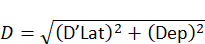
6.4 Course

These formulas are central to all plane sailing problems.
7. Worked Example
Let us consider a practical example.
A ship sails 120 nautical miles on a true course of 045°.
Step 1: Calculate Difference of Latitude


Step 2: Calculate Departure


Interpretation
The ship has moved:
- 84.8 miles north
- 84.8 miles east
This clearly demonstrates how plane sailing converts course and distance into position change.
8. Relationship Between Departure and Longitude
Departure is not the same as difference of longitude.
The relationship is:

Therefore:

This correction is necessary because parallels of latitude get shorter as we move away from the equator.
9. Mean Latitude
Mean latitude is the average of the initial and final latitudes.

It is used to correct departure into difference of longitude.
10. Application of Plane Sailing
Plane sailing is mainly used for:
- Dead Reckoning (DR)
- Short coastal passages
- Exam calculations
- Basic voyage planning
- Cross-checking electronic position
11. Advantages of Plane Sailing
Plane sailing has several advantages:
- Simple and fast calculations
- Requires minimal data
- Easy to visualize
- Accurate for short distances
- Ideal for teaching fundamentals
12. Limitations of Plane Sailing
Despite its usefulness, plane sailing has limitations:
- Inaccuracy over long distances
- Ignores Earth’s curvature
- Not suitable near the poles
- Errors increase with latitude
- Cannot be used for great circle routes
For long ocean passages, Mercator sailing or Great Circle sailing must be used instead.
13. Comparison with Other Sailing Methods
| Method | Earth Model | Best Use |
| Plane Sailing | Flat Earth | Short distances |
| Parallel Sailing | Flat Earth | East–west sailing |
| Mercator Sailing | Cylindrical projection | Rhumb lines |
| Great Circle Sailing | Spherical Earth | Long distances |
Plane sailing is the foundation upon which these advanced methods are built.
14. Examination Importance
In nautical exams, plane sailing questions test:
- Understanding of latitude & longitude
- Trigonometric skills
- Direction sense
- Logical navigation thinking
Common exam tasks include:
- Finding final position
- Calculating course or distance
- Converting departure to longitude
15. Modern Relevance
Even in the age of GPS:
- Plane sailing helps detect position errors
- Builds confidence in manual navigation
- Acts as a backup knowledge system
- Strengthens professional competence
A navigator who understands plane sailing truly understands navigation, not just equipment.
16. Conclusion
To conclude, plane sailing is:
- A simple yet powerful navigation method
- Based on plane trigonometry
- Ideal for short distances
- A cornerstone of nautical science education
It teaches navigators how movement on the Earth is resolved into north–south and east–west components, which is the very essence of marine navigation.
Understanding plane sailing may not just help you pass exams—it shapes you into a thinking navigator, capable of reasoning, verifying, and navigating safely under different condition.
