
What is a Notice of Readiness (NOR) in Shipping?
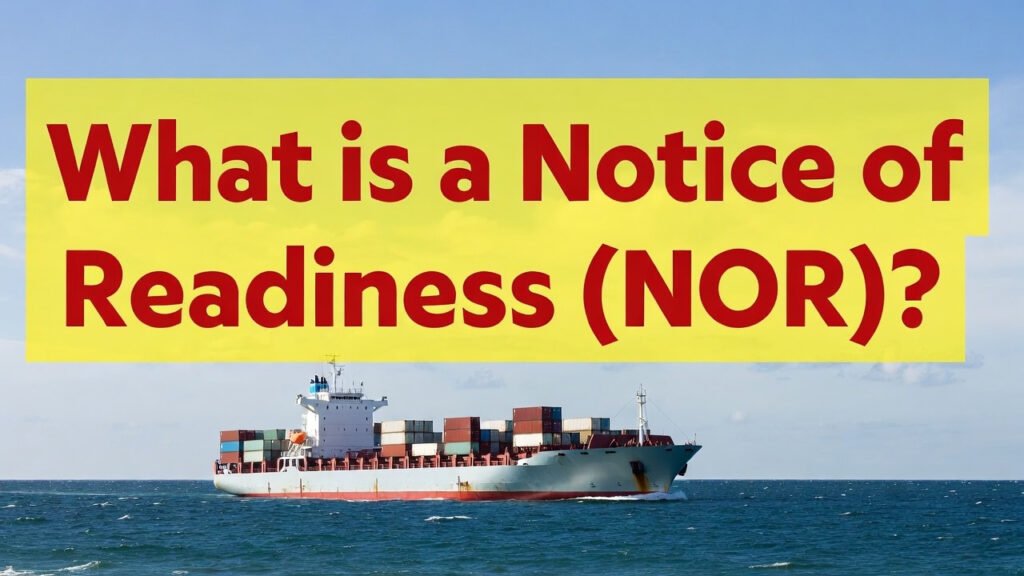
A Notice of Readiness (NOR) is a formal written notice given by the shipowner or master of a vessel to the charterer, consignee, or their agent, stating that the vessel has arrived at the agreed destination and is fully ready in all respects to load or discharge cargo in accordance with the terms of the charter party.
The NOR is one of the most important commercial documents in maritime trade because it triggers the start of laytime (the time allowed for loading or discharging cargo). Laytime calculation directly affects whether the charterer must pay demurrage (if operations exceed laytime) or the shipowner must pay despatch (if operations finish early).
In simple terms:
NOR = Official declaration that the ship is ready to handle cargo and is asking permission to begin operations.
1. Legal Definition and Importance
Under most charter parties (such as GENCON, NYPE, or ASBATANKVOY forms), the master must tender NOR once the vessel has:
- Arrived at the agreed place (port or berth),
- Obtained free pratique (health clearance),
- Completed customs and port formalities,
- Become physically and legally ready to load or discharge cargo.
The NOR is a legal trigger document. Without a valid NOR:
- Laytime does not start,
- Demurrage cannot be claimed,
- The charterer may reject the notice.
Thus, the validity of NOR is frequently a subject of maritime disputes and arbitration.
2. When Can a Vessel Tender NOR?
The right time to tender NOR depends on the type of charter party:
A. Port Charter
Under a port charter, the vessel may tender NOR when she arrives at the port limits, even if she is not yet at berth.
Example:
If congestion delays berthing, but the ship is within port limits and ready in all respects, NOR may be valid.
B. Berth Charter
Under a berth charter, the vessel must reach the specific berth before tendering NOR.
If the vessel is waiting outside due to congestion, NOR is generally invalid until berthed.
3. Conditions for Valid NOR
A Notice of Readiness must satisfy two key conditions:
1. Physical Readiness
The ship must be:
- Cargo holds clean, dry, and ready,
- Cargo gear operational,
- Hatch covers functioning,
- Ballast operations complete,
- Crew ready for cargo operations.
For tankers:
- Tanks cleaned and gas-free (if required),
- Lines and pumps tested.
If holds are dirty or equipment defective, NOR is invalid.
2. Legal Readiness
The vessel must:
- Have free pratique (health clearance),
- Be cleared by customs,
- Have port authority permission,
- Have valid documentation.
If free pratique is pending and required by charter terms, NOR may be invalid.
However, many modern charter parties allow NOR to be tendered even if free pratique is pending, provided no reason to believe it will be refused.
4. Laytime and NOR
Laytime is the time agreed in the charter party for loading or discharge.
Laytime usually begins:
- After NOR is tendered,
- After expiry of a notice period (e.g., 6 hours after NOR),
- During official working hours (unless otherwise agreed).
Example clause:
“Laytime shall commence at 0800 hours next working day after NOR is tendered.”
What Happens After NOR?
- NOR is submitted (usually in writing).
- Charterer or agent acknowledges receipt.
- Laytime countdown begins as per contract.
- Cargo operations start.
- Laytime calculation recorded in Statement of Facts (SOF).
5. Format of Notice of Readiness
A typical NOR includes:
- Vessel name
- Voyage number
- Port name
- Date and time of arrival
- Confirmation vessel is ready in all respects
- Signature of Master or Agent
Sample NOR Format:
To: Charterers / Agents
Dear Sirs,
This is to inform you that m/v “BVB” has arrived at the port of abcd at 0800 hours on 20 February 2026 and is ready in all respects to load/discharge cargo in accordance with the Charter Party dated 01 February 2026.
Kindly acknowledge receipt.
Master
M/V BVB
6. Types of Notice of Readiness
1. Arrival NOR
Tendered upon arrival at port limits.
2. Berth NOR
Tendered upon arrival at berth.
3. Pre-arrival NOR
Some charter parties allow NOR to be tendered before arrival, effective upon arrival.
4. Conditional NOR
Used when readiness depends on certain pending clearances.
7. Rejection of NOR
Charterers may reject NOR if:
- Vessel is not at agreed location,
- Holds are not clean,
- Required documents missing,
- Vessel not physically ready,
- Notice tendered outside permitted hours,
- Notice period clause not followed.
If rejected, laytime does not begin.
8. NOR in Different Types of Shipping
Bulk Carriers
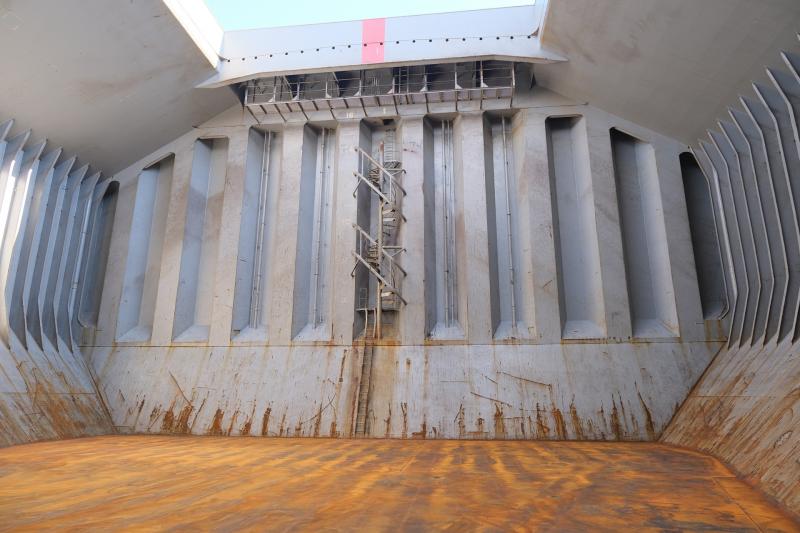
Bulk carriers commonly use NOR in:
- Coal shipments
- Grain shipments
- Iron ore trades
Hold cleanliness inspection is critical. If surveyor fails hold inspection, NOR becomes invalid.
Tankers
For tankers:
- Tanks must be clean and gas-free,
- Cargo lines tested,
- Manifolds ready,
- Shore connection ready.
Tankers often have strict clauses about readiness.
Container Ships
In liner trades, NOR is less significant because:
- Schedule-based operations,
- Freight contracts differ from charter parties,
- Laytime/demurrage works differently.
9. NOR and Demurrage
If cargo operations exceed agreed laytime:
- Charterer pays demurrage (penalty per day).
- Rate fixed in charter party (e.g., USD 15,000 per day).
If operations finish early:
- Shipowner may pay despatch (usually half demurrage rate).
NOR is essential because demurrage calculation depends on valid laytime commencement.
10. Common Legal Cases on NOR
Maritime law includes many arbitration disputes on:
- “Arrived ship” definition,
- Whether port congestion allows NOR,
- Validity of pre-arrival NOR,
- Effect of defective holds,
- Free pratique delays.
English maritime law often governs charter party disputes.
11. Practical Procedure Onboard
For a deck officer or master, NOR procedure includes:
- Confirm vessel within port limits.
- Complete documentation.
- Ensure holds/tanks inspected.
- Obtain clearance from port control.
- Draft NOR.
- Send to agent via email.
- Record time in logbook.
- Get acknowledgment from charterer.
12. Key Clauses Affecting NOR
Important charter party clauses:
- WIBON (Whether In Berth Or Not)
- WIPON (Whether In Port Or Not)
- WIFPON (Whether In Free Pratique Or Not)
- WICCON (Whether In Customs Clearance Or Not)
These clauses allow earlier tendering of NOR even if berth or clearance not available.
13. Difference Between NOR and SOF
| NOR | SOF |
|---|---|
| Declares readiness | Records actual events |
| Starts laytime | Used to calculate laytime |
| Short document | Detailed time log |
| Signed by Master | Signed by Master & Agent |
14. Invalid NOR Consequences
If NOR is invalid:
- Laytime does not start,
- Demurrage claim rejected,
- Financial loss to owner,
- Legal dispute risk.
Example:
If holds fail inspection at 0900 and NOR was tendered at 0800, laytime starts only after holds pass inspection.
15. Electronic NOR
Modern shipping uses:
- Email NOR,
- EDI systems,
- Digital documentation platforms.
But acknowledgment proof is still crucial.
16. Step-by-Step Timeline Example
- Vessel arrives at port limits 0600.
- NOR tendered 0700.
- Notice period: 6 hours.
- Laytime starts 1300.
- Loading begins 1500.
- Total laytime allowed: 3 days.
- Loading completes in 4 days.
- 1 day demurrage payable.
17. Conclusion
The Notice of Readiness (NOR) is a fundamental legal and commercial instrument in maritime trade. It:
- Declares the vessel’s readiness,
- Triggers laytime,
- Determines demurrage/despatch,
- Protects shipowner’s commercial interest,
- Ensures charter party compliance.
A properly drafted and valid NOR can save thousands of dollars in claims, while an invalid NOR can lead to costly disputes.
For maritime professionals — masters, deck officers, port agents, and cadets — a thorough understanding of NOR is essential for safe, efficient, and legally sound cargo operations.
